The Judicial Reform Gamble: When Institutional Strength Becomes Institutional Vulnerability
Claudia Sheinbaum’s first hundred days presented a paradox that will define her presidency. MORENA’s supermajorities in Congress moved quickly to overhaul Mexico’s federal judiciary, replacing career judges through a direct election process. On the surface, this looks like democratic reform. Look closer, and it reveals the core tension that will consume her administration: how to build lasting institutional power while the very institutions she needs keep eroding.

The numbers tell a story of institutional collapse. Sixty-five percent of Mexico’s sitting federal judges either resigned or refused to participate in the retention elections mandated by the reform. This wasn’t passive resistance. It was a coordinated signal that the judiciary had lost confidence in its own independence. When institutions hollow themselves out rather than fight, you’re watching something more serious than a policy dispute. You’re watching the costs of consolidation become visible.
The U.S. State Department’s formal criticism of the judicial reform wasn’t ideological posturing. State was flagging a structural problem: if the judiciary becomes purely responsive to electoral politics rather than insulated by professional norms, Mexico loses the one institutional lever it has for combating organized crime networks. Cartels move through gaps in institutional capacity. They don’t need to defeat the state directly. They need the state to be incoherent enough that they can operate in the friction between branches and agencies.
The Cartel Designation Trap: Why the Trump Administration’s February Move Changes Everything
In February 2025, the Trump administration designated six major Mexican cartels, including the Sinaloa Cartel and the Jalisco New Generation Cartel (CJNG), as Foreign Terrorist Organizations. This was presented as a hardline enforcement move. It was actually something more complicated: a legal reclassification that reshapes the entire American response architecture and, by extension, Mexican state capacity.
The FTO designation isn’t simply rhetorical. It triggers specific legal consequences for financial transactions, asset freezes, and international banking restrictions. More immediately, it creates new thresholds for U.S. military engagement. Special operations forces can operate with different rules of engagement against FTO targets. Intelligence sharing accelerates. The bureaucratic barriers between law enforcement and military operations in counterterrorism cases effectively disappear. In practice, U.S. policy is shifting from treating drug trafficking as a law enforcement problem to treating it as a counterinsurgency problem.
For Sheinbaum, this is a trap disguised as partnership. The Mexican state has always maintained a crucial fiction: that organized crime remains fundamentally a criminal phenomenon, not a political one. Accepting the FTO designation implicitly endorses a framework in which armed cartels are quasi-insurgent forces. That concession opens the door to justifications for military solutions that the Mexican state may not want to execute, or may not be equipped to execute cleanly. It also gives the Trump administration legal cover to conduct operations on Mexican soil with or without explicit Mexican consent.
The Money Problem: Border Seizures, Institutional Capture, and the Economics of Cartel Sovereignty
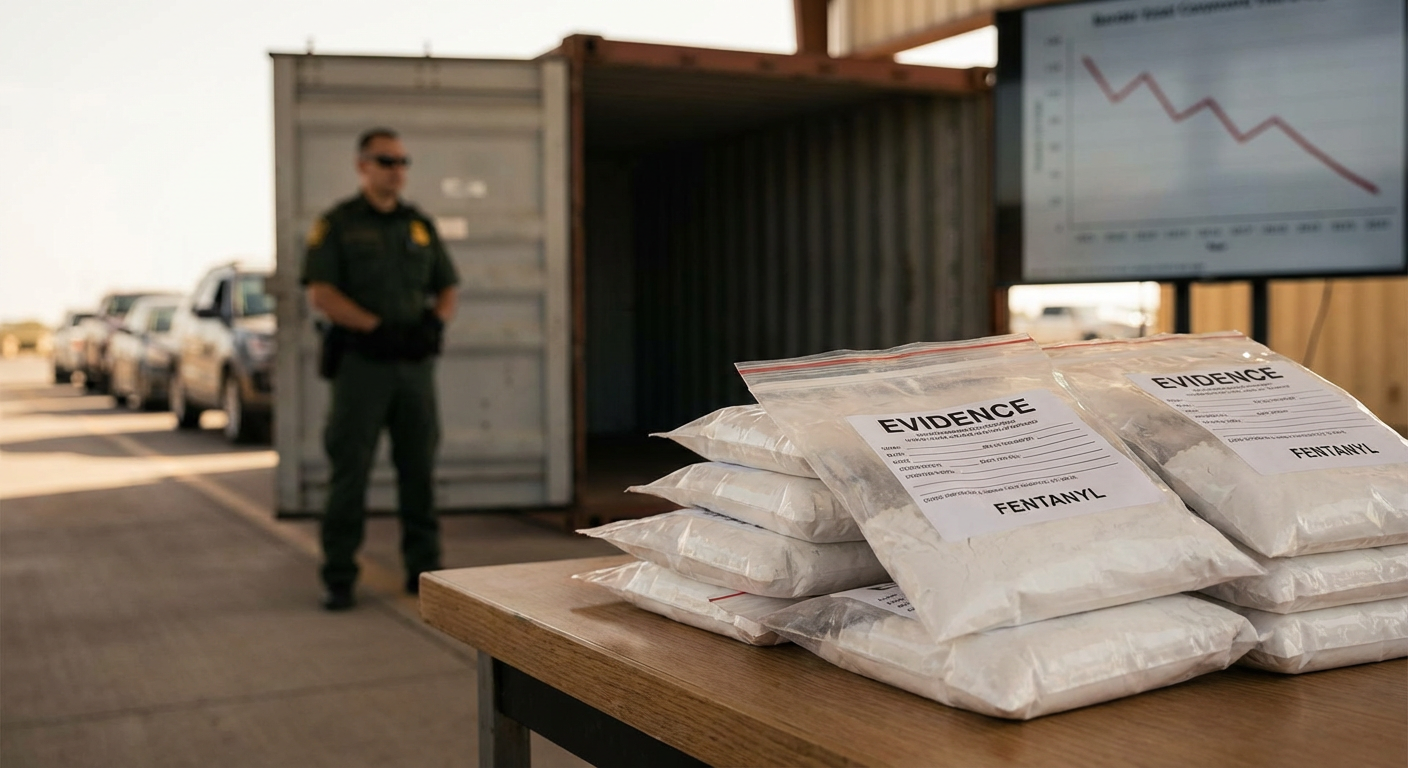
The data on fentanyl seizures at the U.S.-Mexico border tells a story that both governments would prefer to ignore. In fiscal year 2025, U.S. Customs and Border Protection seized approximately 27,000 pounds of fentanyl. That’s an extraordinary volume. Yet simultaneously, CDC preliminary estimates show that U.S. overdose deaths declined for the second consecutive year. This apparent contradiction reveals something important about how organized crime actually operates in the twenty-first century.
High seizure numbers don’t prove enforcement is working. They may prove the opposite. If cartels are moving enough volume that losing 27,000 pounds barely registers in market dynamics, then law enforcement has entered a different kind of competition. You’re not stopping the drug flow. You’re imposing transaction costs on it. As long as those transaction costs stay lower than cartel profit margins, enforcement becomes just another operational expense. The cartels price it in, raise their prices slightly, and continue operations.
This is where the institutional vacancy in Mexico becomes economically material. U.S. Customs and Border Protection Fentanyl Seizure Statistics show the volume, but they don’t show what’s happening to the money. And the money is the story. Cartels don’t need to govern territory the way historical insurgencies did. They need to move capital. That requires banking relationships, currency exchange infrastructure, and security guarantees for financial networks. Some of that happens through corruption of public officials. Some of it happens through sophisticated international money laundering. A significant portion happens through direct capture of local institutions.
When local officials face assassination for non-cooperation, the economics of the transaction shift dramatically. The Wilson Center Mexico Institute Political Violence Tracker documented forty-seven assassinations of sitting or recently elected local officials between January and October 2025, the highest rate on record. This isn’t random violence. It’s infrastructure maintenance. These killings send signals about the cost of institutional resistance. They’re investments in future cooperation.
MORENA’s Consolidation Problem: Can You Build State Capacity by Weakening Institutions?
Sheinbaum inherited a political environment where MORENA controlled both chambers of Congress with supermajorities. Extraordinary power. Also unstable power, because it’s concentrated in a single movement without the stabilizing friction of genuine opposition oversight. The judicial reform revealed this instability. MORENA used its supermajority to remake the judiciary, but in doing so created a judicial branch that no longer has internal legitimacy. You’ve won control of an institution by destroying its independence.
This creates a recursive problem. MORENA’s political dominance depends on delivering results: combating corruption, reducing violence, improving services. But the institutional tools for delivering those results have been compromised in the process of securing MORENA’s control. You now have a party with tremendous formal power but increasingly limited institutional capacity to exercise that power effectively. When the judicial system can’t make independent decisions because judges know their retention depends on political loyalty, the entire anticorruption agenda becomes suspect.
The cartel violence data intersects with this institutional problem directly. If local governance becomes too dangerous, talented administrators stop seeking office. If the judiciary has no independence, convictions of powerful criminals become unreliable. If federal judges are politically responsive, cartel-connected defendants can shop for favorable judicial assignments. The Mexican state hasn’t lost control of territory to cartels because it lacks military force. It’s lost control because the institutional pathways for translating force into sustainable governance have degraded.
What Comes Next: Reading the Room Between Mexico City and Washington
Sheinbaum’s options are genuinely constrained. The Trump administration’s FTO designations create pressure for more aggressive security operations. The judicial reform has weakened institutional guardrails against military overreach. The local official assassinations signal that cartel networks can impose costs on administrative capacity. And MORENA’s institutional consolidation, even as it expands formal executive power, may be shrinking the effective state capacity to use that power.
The most likely scenario isn’t a dramatic policy shift. It’s incremental institutional deterioration masked by superficial enforcement activity. More interdiction at the border. More military operations in cartel strongholds. More judicial convictions of mid-level operatives with questionable procedural legitimacy. Meanwhile, the cartels adapt by becoming more embedded in local economies, more sophisticated in their money laundering, and more strategic in their use of violence to impose costs on institutional cooperation.
Where does this leave the fundamental problem of state capacity? Probably unchanged. Sheinbaum’s first year will be read as a test of whether political consolidation can substitute for institutional reform. So far, the data suggests it cannot. The seizures continue. The officials keep dying. The violence persists. And the justices keep quitting.