The Setup: Why Immigration Enforcement Became a State-Level Power Struggle
When the Trump administration issued its January 2025 executive orders dramatically expanding interior immigration enforcement, something interesting happened. Rather than a unified federal police action rolling out across the country, we watched a fractured response emerge almost immediately. At least eleven governors, including those of California, Illinois, Colorado, and New York, issued executive directives that actively limited state and local law enforcement cooperation with ICE operations. On the surface, this looks like simple partisan resistance. Dig deeper and you find a genuine structural conflict about who pays for what, who bears legal risk, and who answers to whom.

The reason this matters for understanding 2025 is straightforward. Federal immigration enforcement is technically a federal responsibility. But in practice, ICE relies heavily on state and local partners for intelligence, detention space, and coordination. When governors tell their law enforcement agencies to stop sharing information or cooperating with federal agents, the machinery doesn’t just slow down. It jams. The federal government loses access to state databases, prisoner lists, and local police officers who can make referrals. This isn’t abstract constitutional theory. It’s a concrete economic and operational constraint.
What makes this particularly sharp in 2025 is the scale. ICE reported over 185,000 interior arrests in Fiscal Year 2025, the highest annual total since 2011. That number sits at the intersection of two competing political realities. For the Trump administration, it represents vindication of a more aggressive enforcement philosophy. For the governors pushing back, it represents something else: a warning about the resource burden, community trust costs, and legal exposure that comes with enabling that enforcement.
The Legal Weaponry: How the Courts Became the Real Arena
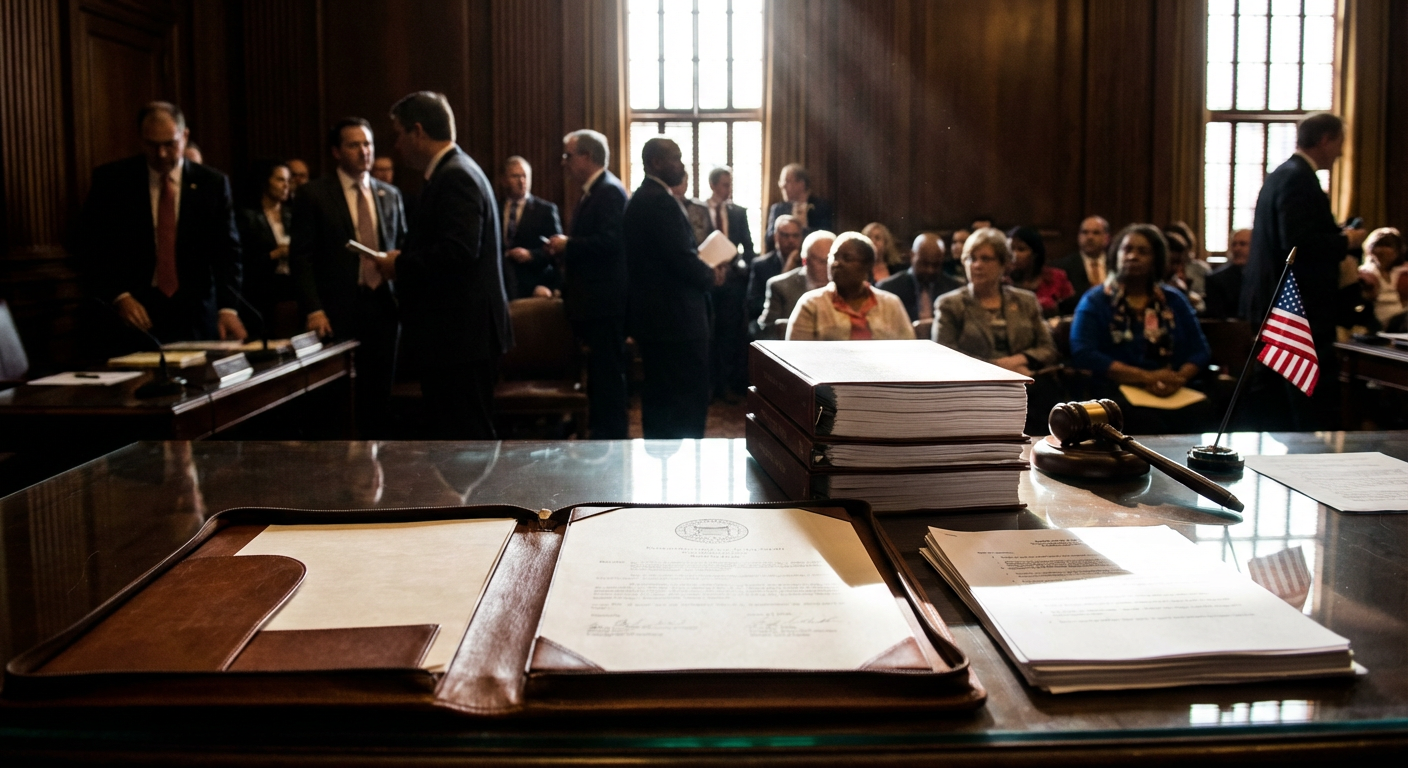
By mid-2025, the Department of Justice had filed federal preemption lawsuits against four states. The argument was familiar from previous immigration debates. States cannot, Justice Department lawyers contended, use their police powers to obstruct federal immigration enforcement. The Constitution’s Supremacy Clause hands immigration exclusively to the federal government. State laws that undermine this authority are simply invalid, regardless of local political preferences.
But here’s where the political economy gets interesting. A preliminary injunction issued by the U.S. District Court for the Northern District of Illinois in July 2025 blocked portions of the federal enforcement directive itself. This wasn’t a state court protecting a state law. This was a federal court finding that the federal government’s own executive action may have exceeded its authority or lacked proper procedural justification. The case revealed something important about the separation of powers in 2025: the judiciary maintains real leverage over enforcement priorities, and disagreements about immigration don’t automatically resolve in the executive’s favor, even when it controls both branches.
The legal battle also created genuine uncertainty for state officials. If you’re a governor or attorney general, you face a real cost-benefit calculation. Cooperating with ICE means potential legal liability and political backlash from constituents. Refusing means possible federal preemption suits and resource commitments to defend state policy. Neither choice is costless. This uncertainty itself becomes a form of pressure, freezing many officials somewhere between compliance and resistance.
The Legislative Response: Forty-Seven Bills and Counting
State legislatures moved quickly to codify their positions. According to the National Conference of State Legislatures: Immigration Policy Database, forty-seven state-level bills were introduced in 2025 dealing specifically with state and local enforcement of federal immigration priorities. Of those, fourteen were signed into law. That’s a significant proportion, suggesting real momentum behind legislative change rather than isolated executive action.
These bills took various forms. Some prohibited state funds from supporting ICE enforcement. Others limited information-sharing between state agencies and federal immigration authorities. Still others created legal protections for undocumented immigrants within state jurisdictions, essentially raising the cost of federal enforcement by removing cooperative state infrastructure. The financial dimension here is worth pausing on. States were willing to spend political capital and money to obstruct federal enforcement. That only makes sense if governors calculated that the political benefits of resistance exceeded the costs of potential legal defeat and federal pressure.
This legislative activity also revealed regional patterns. Western and Northeastern states clustered toward resistance. Southern and Great Plains states showed more variation. And this wasn’t simply a partisan map. Democratic-controlled states uniformly resisted, yes. But some Republican-controlled states, particularly those with significant Latino populations or agricultural economies dependent on immigrant labor, also hedged their bets or quietly declined to maximize cooperation with ICE. The actual political economy was messier than the partisan narrative suggested.
The Evidence Problem: Data and Disagreement About What Works
One of the more revealing moments in 2025 came when empirical research actually entered the policy debate in a consequential way. A September 2025 study from the Stanford Immigration Policy Lab Research found that counties with sanctuary policies experienced no statistically significant difference in violent crime rates compared to non-sanctuary counties. This cut directly through one of the federal government’s key justifications for aggressive interior enforcement: the claim that limiting ICE cooperation somehow makes communities less safe.
The study didn’t end the debate. Of course it didn’t. But it gave governors empirical ground to stand on. Instead of merely asserting that sanctuary policies were defensible, they could point to actual data. The federal government countered with its own crime statistics and anecdotal evidence. The underlying dispute remained unresolved. But the data shifted what kind of disagreement this was, making it slightly harder to dismiss state resistance as purely ideological.
This points to something worth noting about governance in 2025. Policy arguments increasingly split into separate empirical universes. Both the federal government and resistant states could claim evidence supported their position. Both could find studies, statistics, and individual cases that validated their approach. The fundamental disagreement wasn’t really about facts. It was about values, priorities, and who should bear the costs of different enforcement levels. Facts matter, but they rarely resolve those kinds of conflicts.
The Unresolved Tensions: Who Pays and Who Decides
By late 2025, the situation had settled into an uneasy equilibrium. The federal government could conduct more aggressive interior enforcement in cooperative jurisdictions, but faced genuine operational constraints in resistant states. ICE’s 185,000 annual arrests, while substantial, still represented only a tiny fraction of the estimated undocumented population. The states that pushed back had successfully imposed real friction on federal enforcement without breaking the system entirely.
What remains unresolved is the fundamental question of incentives. Federal officials benefit politically from high enforcement numbers, but they don’t pay the direct costs. State and local officials pay those costs in community trust, litigation expenses, and resource allocation. This misalignment between who benefits and who pays is the real story underneath the constitutional arguments and political theater. Until that incentive structure changes, expect continued fragmentation in how immigration enforcement actually operates across different jurisdictions.
New court rulings may clarify preemption questions. Electoral shifts could change the composition of resistant states. Budget pressures might force changes in how states prioritize competing demands on law enforcement resources. But the underlying tension between federal immigration authority and state sovereignty looks structural, not situational. It will outlast whatever specific policies are on the books right now. If you’re trying to understand how federalism actually works in contemporary America, this particular conflict is about as clear a window as you’re going to get.